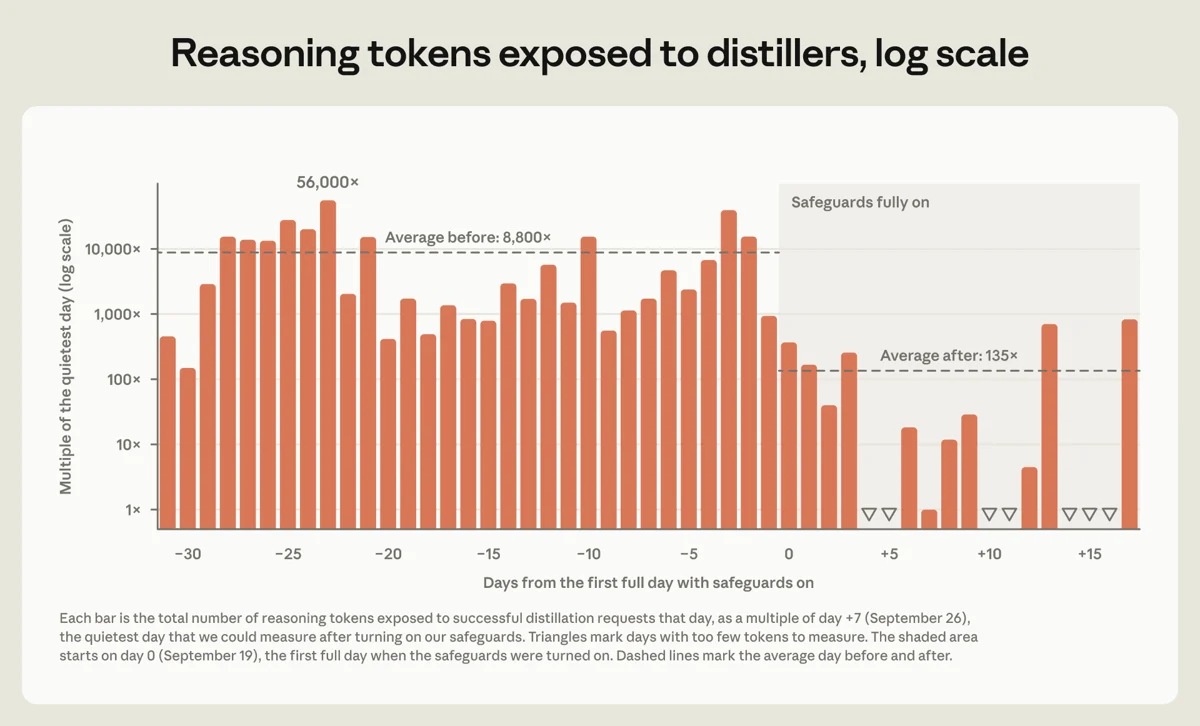
Anthropic says it has made large-scale attempts to copy Claude substantially less productive. In research published October 12, the company reports that new safeguards reduced the reasoning data harvested on its platform by roughly 90–99%.
The claim concerns unauthorized extraction campaigns. Distillation itself is also a legitimate machine-learning technique: a smaller model can learn from a larger model’s outputs when the developer has permission to use them.
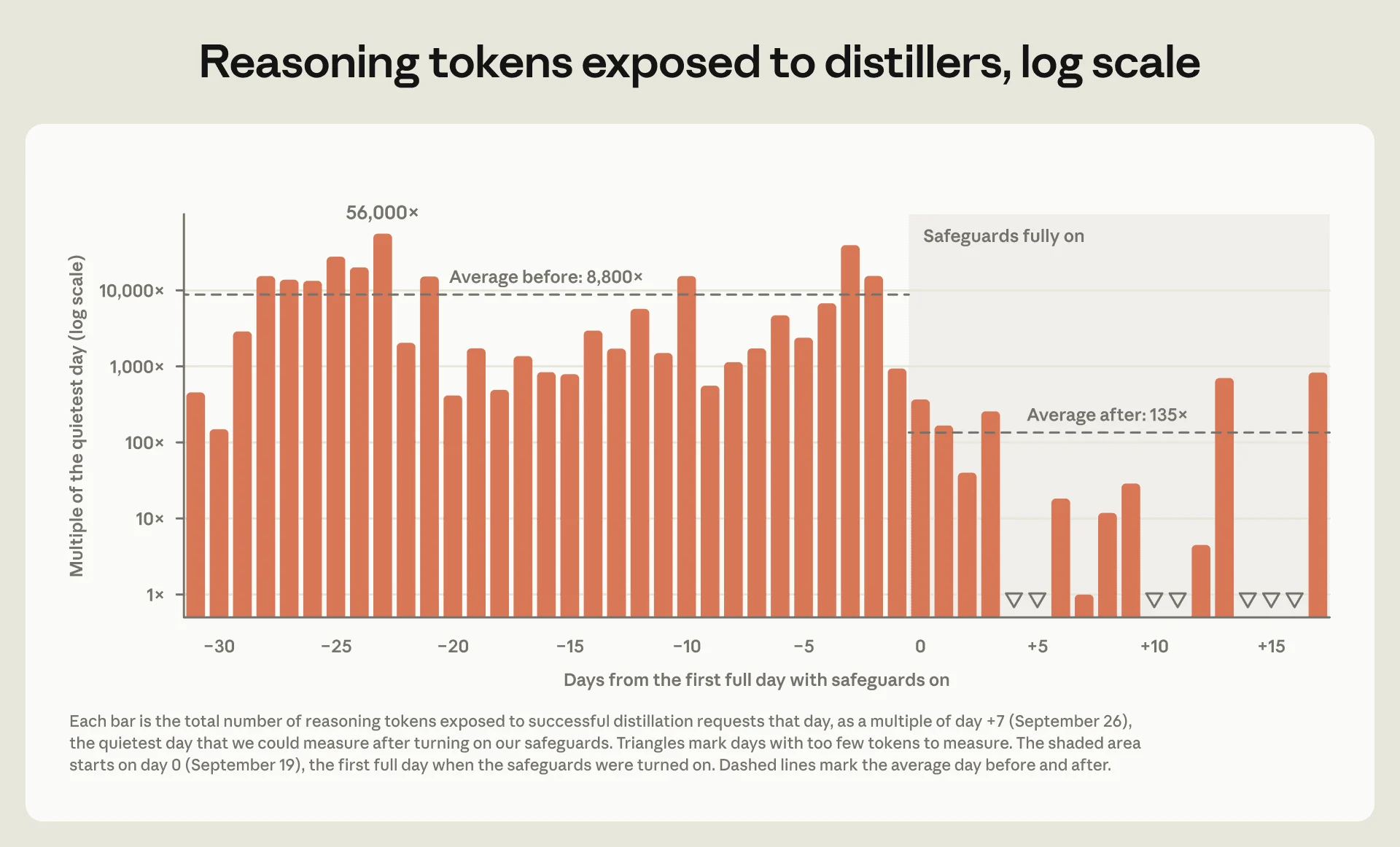
Image credit: Anthropic
What changed
Anthropic describes three layers: tighter controls on where protected reasoning can travel, a two-stage classifier that detects extraction attempts, and account restrictions that make repeated attempts more expensive.
The company says it has banned tens of thousands of associated accounts. Its chart tracks exposed reasoning tokens on its own platform, using a logarithmic scale; it is a company measurement, not an independent industry-wide audit.
There are costs for ordinary developers
Anthropic acknowledges that preserved-thinking changes required some integrations to be updated. It reports a false-positive rate below 0.1% for the relevant safeguards and says it has resumed charging for certain requests blocked before an answer is produced.
It also cautions that the gains may not last and that a highly sophisticated, persistent attempt could test the defenses further.
The distinction to watch is between fewer successful extraction requests and proof that model copying has stopped. This research supports the former. Developers should also inspect failed-request billing and integration changes when judging the impact on their own applications.
Source: Anthropic’s research and chart.



No comments yet