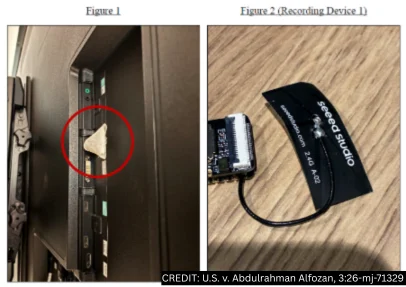
An OpenAI engineer has been arrested and charged after investigators allegedly found a concealed audio recorder in an executive conference room at the company’s San Francisco offices. The Justice Department announced the case on October 13. OpenAI separately confirmed that it discovered a hidden device, referred the matter to the FBI and fired the employee.
There is an important distinction in what has been disclosed so far: this is an alleged physical recording and insider-security incident. OpenAI says it currently has no indication that the individual improperly accessed or removed model weights, source code or customer data. The public statements do not establish a breach of ChatGPT users’ conversations or accounts.
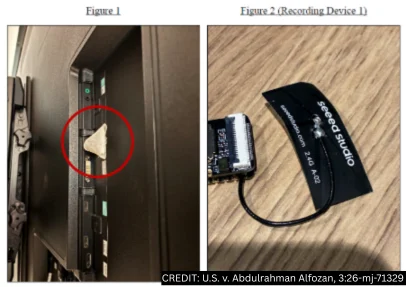
Image credit: U.S. Department of Justice / U.S. Attorney’s Office, Northern District of California
What prosecutors allege happened
According to the Justice Department’s release, employees discovered the first device around September 30. It was connected to a USB port behind a television and concealed in toilet paper. OpenAI determined that it had been installed around September 28 and that its contents were encrypted.
Prosecutors identify the defendant as Abdulrahman Alfozan, 35, an engineer who had worked at OpenAI since July 2025. They say he was arrested October 9 and made his initial federal court appearance October 13. The charge concerns using, or attempting to use, a device to intercept oral communications. These are allegations, not findings of guilt; he is presumed innocent unless proved guilty in court.
The room matters to the case because prosecutors say it was used for confidential research discussions, product planning, business strategy and meetings involving outside relationships. The allegation is therefore about potentially capturing sensitive spoken conversations, rather than merely placing an unfamiliar gadget in an ordinary workspace.
The timeline described in the release
- September 24–30: Prosecutors say a chatbot account associated with the employee’s spouse submitted questions about constructing, concealing and remotely accessing a recorder. They allege that the account shared identifiers with the employee’s own account.
- Around September 28: OpenAI dates the recorder’s installation to approximately this day.
- Around September 30: Employees discovered the device behind the television.
- October 5: Prosecutors say surveillance footage showed the employee looking behind that television. Security personnel also allegedly found a similar device in an unattended bag containing his wallet and identification.
- October 9: The arrest took place.
- October 13: The case and initial court appearance were publicly announced.
The Justice Department also alleges that earlier queries through a productivity tool concerned office locations, meeting rooms and leadership calendars. These details describe the prosecution’s evidence; they do not establish who heard any recording, whether recordings were transmitted, or the employee’s motive.
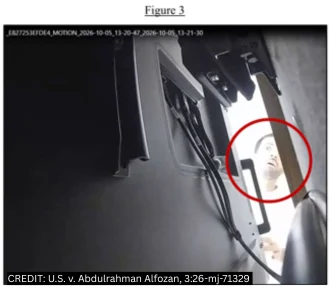
Image credit: U.S. Department of Justice / U.S. Attorney’s Office, Northern District of California
What OpenAI said on X
In its October 13 statement, OpenAI says its models helped staff understand the device and identify where it came from. The company says it referred the matter to the FBI, whose investigation remains ongoing, and terminated the employee.
OpenAI has not publicly explained the exact model workflow or provided an independent evaluation of its contribution to the investigation. The claim that AI helped identify the device’s origin should therefore remain attributed to the company.
BNO News also reported the arrest, and posted the news on X. The account here draws primarily on the Justice Department’s release and OpenAI’s own statement.
What remains unanswered
Neither statement establishes what audio was successfully captured, whether anyone outside the company received it, or whether another organization directed the alleged conduct. Nationality alone is not evidence of government involvement, and the publicly described charge should not be expanded into an unsupported espionage claim.
OpenAI’s statement about customer data is also carefully limited to what it has found at this time. It is not a claim that the investigation is finished, nor is the discovery itself proof that customer information was stolen.
The Justice Department says the charge carries a maximum of five years in prison and a $250,000 fine, followed by three years of supervised release, if there is a conviction. Those are statutory maximums cited by prosecutors, not a sentence that has been imposed.
For readers following the story, the next meaningful developments would be court filings, a defense response and any further findings about the device’s contents. Until then, the confirmed company response and the prosecutors’ allegations should remain clearly separated.



No comments yet