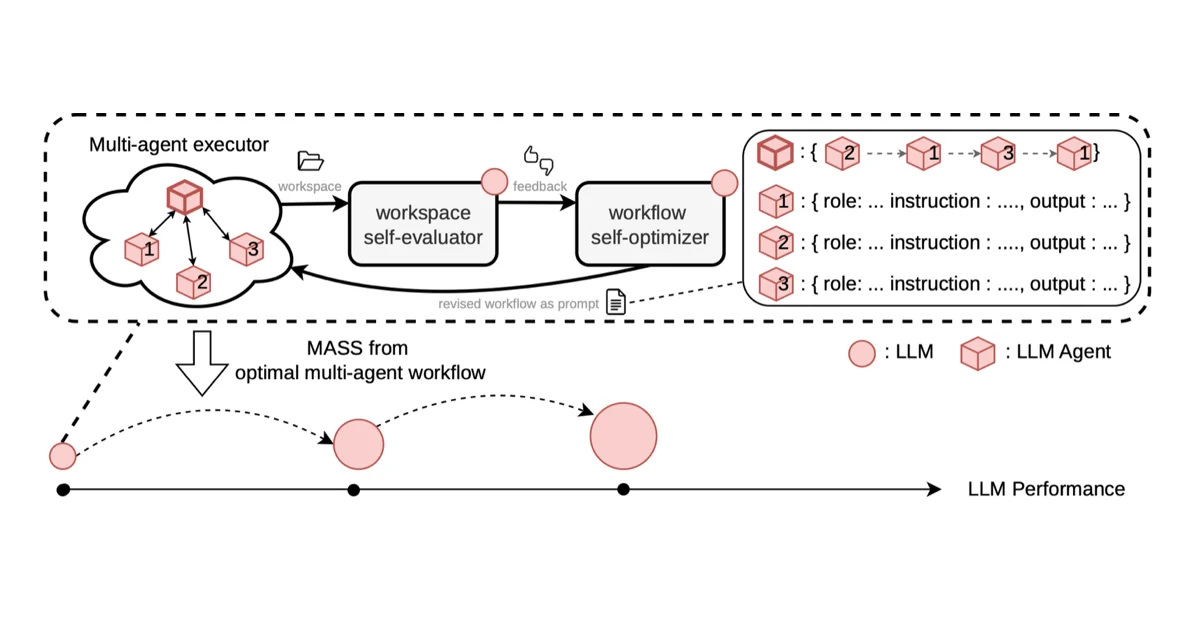
An AI model can learn from a team made up of copies of itself. That is the idea behind Multi-Agent Self-Supervision, or MASS, which Sakana AI announced on October 12. The research explores how an AI system might improve its work when a stronger supervisor is unavailable.
The paper assigns one shared model three jobs: carry out research, judge the results and revise how the team works. It searches for better ways to divide tasks and pass information between agents, then trains the shared model on selected runs. The updated model takes over all three jobs for the next round. The researchers tested two rounds using Qwen3.6-27B.
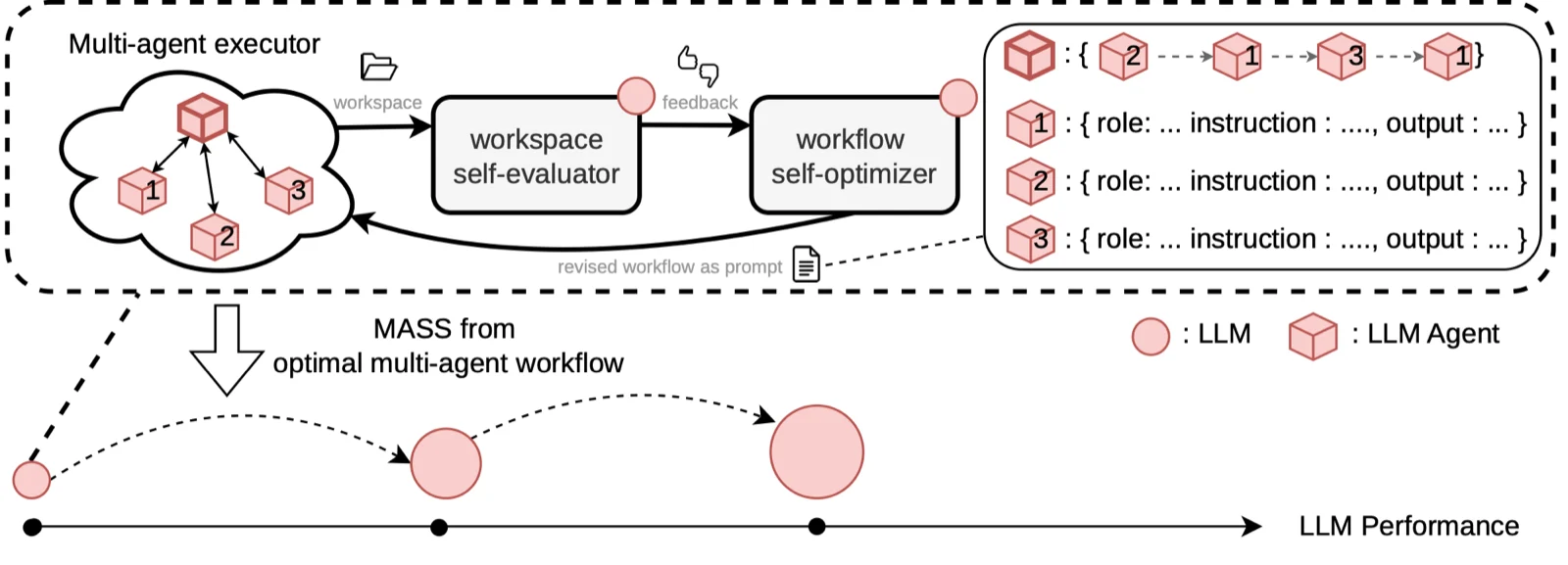
Image credit: Sakana AI and the MASS research authors.
In the reported results, score per output token improved by 1.2 to 1.6 times across four public research benchmarks. That measures the relationship between results and generated text; it should not be read as every answer becoming 60% more accurate. The chart also shows small declines on two coding benchmarks. Separate AI judges assessed the research outputs without supplying feedback to the learning loop.
The useful idea here is teaching a model how to organize work, including what evidence each agent must hand to the next. For builders, that suggests testing the coordination process alongside the final answer. The limits matter too: copies of one model can share the same mistakes, and self-evaluation can preserve those mistakes. MASS offers evidence from a bounded experiment, with its paper and code available for inspection.
*Image credit: Sakana AI and the MASS research authors.*



No comments yet