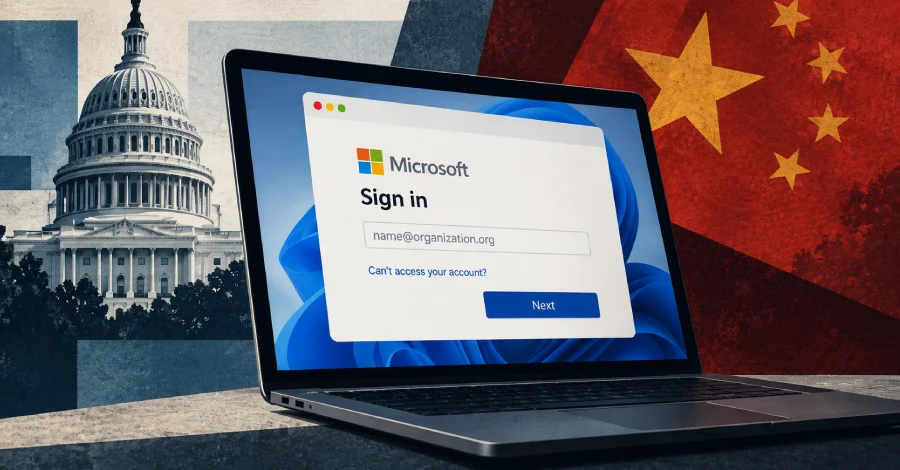
A China-aligned espionage group is targeting the people who shape American AI policy, according to new research from security company Proofpoint. The group, which Proofpoint tracks as TA419, has been running credential phishing campaigns against AI experts at US think tanks, universities and law firms.
Image: Illustration: China-linked phishing targeting Microsoft accounts. Credit: The Hacker News.
Image: Illustration: China-linked phishing targeting Microsoft accounts. Credit: The Hacker News.
How the scam works
TA419 plays a long game. It doesn't open with a malicious link:
- It builds trust first. The first email is a harmless invitation from someone who looks credible. The group has impersonated well-known economists, AI policymakers, a former member of the White House Office of Science and Technology Policy, and a prominent Anthropic employee. One February email carried the subject line “Request for Feedback on Military Integration of Claude.”
- It only strikes after a reply. Once the target responds, the attacker sends a shortened link that bounces through several redirects, and even a Cloudflare Turnstile check, before landing on a fake Microsoft OneDrive sign-in.
- The login looks real because it is. The page uses a “frameless browser-in-the-browser” trick to draw a convincing fake sign-in window, while an adversary-in-the-middle proxy passes your details to Microsoft's real servers. You sign in successfully, and the attacker quietly keeps your session cookies.
Why AI policy people?
“This activity likely supports wider Chinese intelligence objectives to better understand ongoing developments within the U.S. AI policy and regulatory landscape,” Proofpoint said, pointing to tension over export controls and accusations of model distillation. TA419 has targeted defence, energy and foreign-policy experts in the US and Japan since at least April 2025, so AI is an extension of its usual work rather than a new direction.
How to protect yourself
- Use passkeys or hardware security keys. Phishing-resistant sign-in is the strongest defence against session-stealing proxies like this one.
- Be wary of flattering, unsolicited outreach, especially requests for “expert feedback”. Check with the person through a channel you already trust before you click anything.
- Watch for login pages after a redirect chain. If an email link sends you to a sign-in page, close it and go to the service directly.
If you work anywhere near AI policy, assume you're on someone's list.
Sources
- The Hacker News: China-aligned TA419 targets U.S. AI policy experts with Microsoft AitM phishing
- Proofpoint Threat Insight blog
This article was written by builtwai based on the reporting linked above. Quotes are attributed to their original sources.



No comments yet